

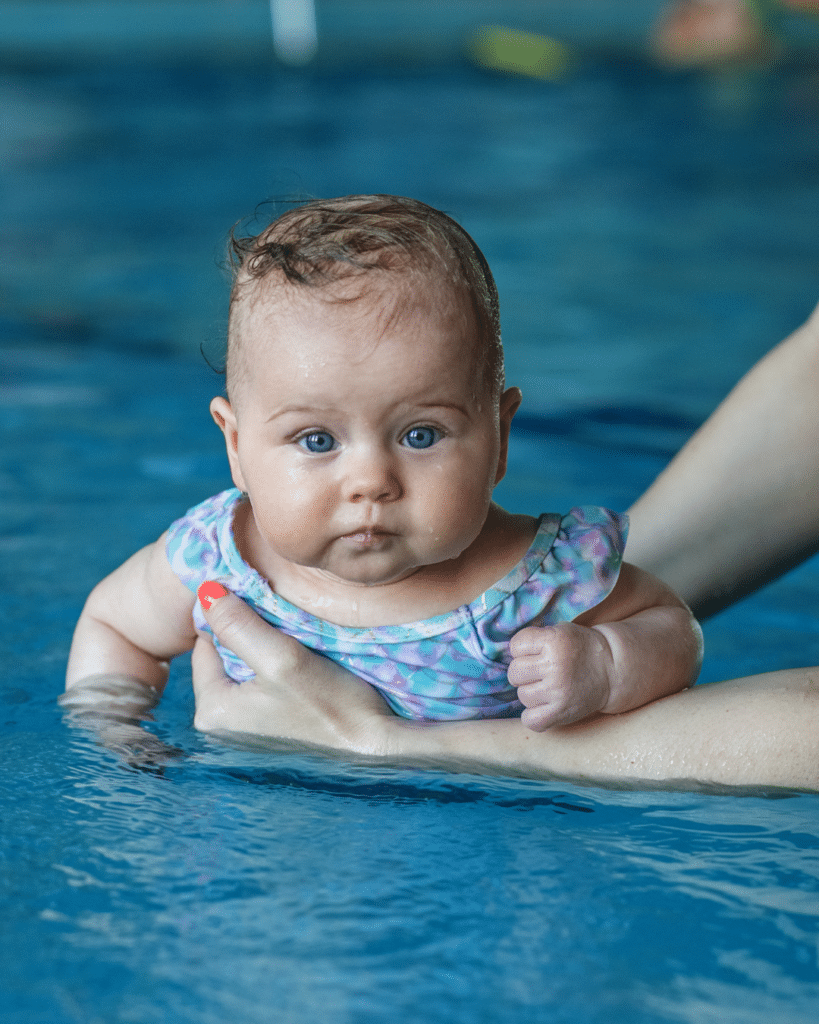
When most parents enroll their baby in swim lessons, their primary goal is water safety. And that’s an important one. But what many families don’t realize is that infant swim lessons can also play a meaningful role in early brain development and motor skill growth.
During the first few years of life, a baby’s brain develops at an extraordinary pace. Neural connections are forming rapidly, motor pathways are strengthening, and foundational skills for movement and learning are taking shape. The water environment—when guided by trained instructors in a structured program—can support that development in unique ways.
At Blue Dolphin Swim School, our Baby Love Infant Swim program is designed to promote safety, confidence, and healthy development in age-appropriate ways.
The Water Environment: A Unique Developmental Setting
Water offers something land cannot: buoyancy and gentle resistance at the same time.
On land, babies are limited by gravity. In the pool, buoyancy allows them to move their arms and legs more freely, experimenting with coordinated motion before they can fully do so on solid ground. At the same time, water provides natural resistance, which strengthens muscles and encourages controlled movement.
This combination supports:
Improved coordination
Better balance
Stronger core, arm, and leg muscles
Enhanced body awareness
These early physical skills create the foundation for milestones like rolling, sitting, crawling, and eventually walking.
Cross-Lateral Movement and Brain Development
One of the most important aspects of infant swim lessons is cross-lateral movement—when babies use both sides of their bodies in coordinated patterns.
For example:
Rolling from front to back
Reaching across the body during supported glides
Monkey walking on the wall after learning how to hold the wall for 5 seconds independently
Cross-lateral movement strengthens communication between the two hemispheres of the brain. This type of bilateral coordination helps develop neural pathways involved in balance, motor planning, and spatial awareness.
Research has suggested that early swimmers often demonstrate strong visual-motor skills and early problem-solving abilities compared to peers without similar movement experiences. While every child develops at their own pace, structured movement in a sensory-rich environment supports healthy neurological growth.
Strengthening Gross and Fine Motor Skills
Infant swim lessons primarily target gross motor development—the large muscle movements of the arms, legs, and core. But they also contribute to fine motor growth in subtle ways.
Gross Motor Benefits:
Stronger neck and trunk control
Improved posture and stability
Better coordination between limbs
Fine Motor Benefits:
Gripping toys during water activities
Hand-eye coordination during guided movement
Improved body control and timing
These skills lay the groundwork for future tasks like feeding independently, grasping objects, writing, and participating in sports.
Brain Stimulation Through Sensory Input
The pool is a multi-sensory environment. Babies experience:
The feel of water against their skin
The sound of splashing and instructor cues
Visual tracking of movement
Changes in body position
This type of sensory engagement stimulates neural activity. The repetition of movement patterns—combined with verbal cues—helps strengthen memory and learning pathways in the brain.
Some long-term studies have observed that children who participated in early swim programs demonstrated advanced performance in areas like spatial reasoning and early math skills. While swim lessons are not an academic shortcut, they do provide structured physical activity that supports overall cognitive growth.
Emotional Regulation and Confidence
Brain development isn’t only cognitive—it’s emotional.
Learning to manage new sensations, regulate breathing, and trust an instructor helps babies build emotional resilience. Repetition in swim lessons teaches predictability, which lowers stress responses and builds confidence.
Over time, babies who become comfortable in the water often show:
Increased independence
Better adaptability to new environments
Improved self-regulation
These traits support both early childhood development and long-term learning readiness.
The Importance of Consistency
Developmental benefits are strongest when lessons are consistent and age-appropriate. Regular attendance reinforces motor patterns, strengthens neural pathways, and builds familiarity with the aquatic environment.
At Blue Dolphin Swim School, we emphasize:
Structured, progressive instruction
Safe, warm water environments
Developmentally appropriate pacing
Parent involvement and support
Our goal is to nurture a positive relationship with the water while supporting healthy physical and neurological development.
A Foundation for Lifelong Skills
Infant swim lessons are not about producing advanced swimmers at an early age. They’re about building:
Water safety awareness
Strong motor foundations
Early neural connections
Confidence in movement
When babies experience guided, supportive swim instruction, they gain more than just water comfort—they build skills that contribute to their overall growth.
Give Your Baby a Strong Start
If you’re looking for a safe, structured way to support your baby’s physical and cognitive development, Blue Dolphin Swim School is here to help.
Our Baby Love Infant Swim program focuses on water safety, confidence, and age-appropriate motor development—led by trained instructors who understand early childhood growth.
Visit Blue Dolphin Swim School today to learn more or enroll your baby in infant swim lessons. Help your child build strength, confidence, and healthy development from the very beginning.
FAQ: Infant Swim Lessons and Development
Yes. Repetitive, coordinated movement and multi-sensory experiences in water help strengthen neural connections involved in balance, memory, and motor planning.
While every child develops at their own pace, swim lessons can strengthen core and leg muscles that support crawling and walking milestones.
When conducted in a properly supervised, warm, and structured environment by trained instructors, infant swim lessons are developmentally appropriate and safe.
Consistency matters. Regular weekly lessons help reinforce motor patterns and build confidence.
No. Swim lessons complement tummy time, play, and other activities that support healthy growth.