What Makes a Great Swim Instructor? What Boulder & Louisville Parents Should Look For
7 min read
By Blue Dolphin Swim School
Your learning focus
A clearer picture before the next step.
Discover what makes a great swim instructor for babies and toddlers, from patience and safety training to fun, personalized lessons for Boulder and Louisville families. Browse the website for more details.
Choosing an instructor means looking beyond a pool photo or a program name. Watch how the teacher supports your child, explains an activity, and responds when something feels unfamiliar. A useful fit depends on your child’s current needs rather than a promised number of weeks to progress.
Families in Boulder and Louisville can compare schools by asking concrete questions: who teaches the class, what preparation that person has, how supervision works, and how parents hear about progress. A friendly tour is a starting point; clear answers about the actual class matter more.
Use the following observations and questions to compare instruction without assuming that every school or teacher has the same credentials or teaching approach.
Patience Is a Skill, Not a Personality Trait
Patience is visible in small moments: giving a child time to respond, explaining what comes next, and changing an activity when the child is uncomfortable. Observe those interactions rather than treating a child’s pace as a problem to overcome.
If you watch a class and the instructor seems frustrated, rushed, or checked out when a child cries, that is your answer. Move on.
Real Certifications, Not Framed Ones
Ask which instructor qualifications apply to the person teaching your child and whether relevant credentials are current. Discuss CPR, first aid, age-specific teaching preparation, and who is responsible for lifeguarding or emergency response. Those are separate roles; a swimming job title alone does not establish any of them.
Water for babies is a specialty. It is not the same as teaching a seven-year-old to swim freestyle. The person holding your six-month-old should have training that reflects that difference.
Communication That Goes Both Ways
Good instructors talk to babies. Great ones also talk to parents. Every family should leave a lesson knowing three things: what their child worked on today, what they struggled with, and what to practice at home before the next session. If the only feedback you ever get is "she did great," ask more questions. If those questions still land nowhere, you have a communication problem.
Ask how feedback is shared after a lesson. A useful update names one skill being practiced, what support the child needed, and what question to discuss next. Any practice outside class should be specifically recommended for your child and appropriately supervised.
They Actually Make It Fun
Babies do not respond to instructions. They respond to songs, silly voices, funny faces, and the same goofy game played forty times without a single sigh of boredom. If you sit deck-side and the instructor looks tired or flat, so will your child within about ninety seconds.
Look for attentive, warm engagement that fits your child. A teacher can be playful without rushing an activity or overlooking discomfort. Ask how the class changes when a child needs more time.
What Boulder and Louisville Families Should Think About Specifically
Families may encounter pools, reservoirs, and lakes with very different conditions. Ask how a program explains those differences, while keeping its actual pool lesson goals separate from preparation for open-water activities.
Pool instruction and open-water conditions are different. Ask how the program builds age-appropriate skills, and do not assume an infant lesson prepares a baby for cold water or an unexpected fall. Supervision, barriers, and appropriate life jackets remain essential.
Ask any school you tour how they prepare children for the local environment. If they only talk about pools, they are missing half the picture.
Compare Private and Group Lesson Formats
Blue Dolphin’s Learn to Swim page describes private beginner lessons. That is a program format, not proof that one approach guarantees faster learning for every child.
Blue Dolphin lists one-to-one Learn to Swim lessons through Turtle, Octopus, and Stingray. Individual attention gives the instructor one swimmer to focus on; it does not guarantee a faster outcome. Choose placement by the program’s stated skills and an assessment rather than a generic swim-across-the-pool rule.
The Baby Love program has a parent-and-baby group option and a private infant option. Its group listing allows up to five parent-and-infant pairs, while Learn to Swim is described as private instruction. Ask about the exact format and class size for the next level instead of assuming a universal four-to-one ratio.
When comparing formats, ask how much support each swimmer receives, what children do between turns, and which skills are expected before joining. Group and private instruction serve different needs; the label alone does not establish quality.
What to Watch on Your Trial Visit
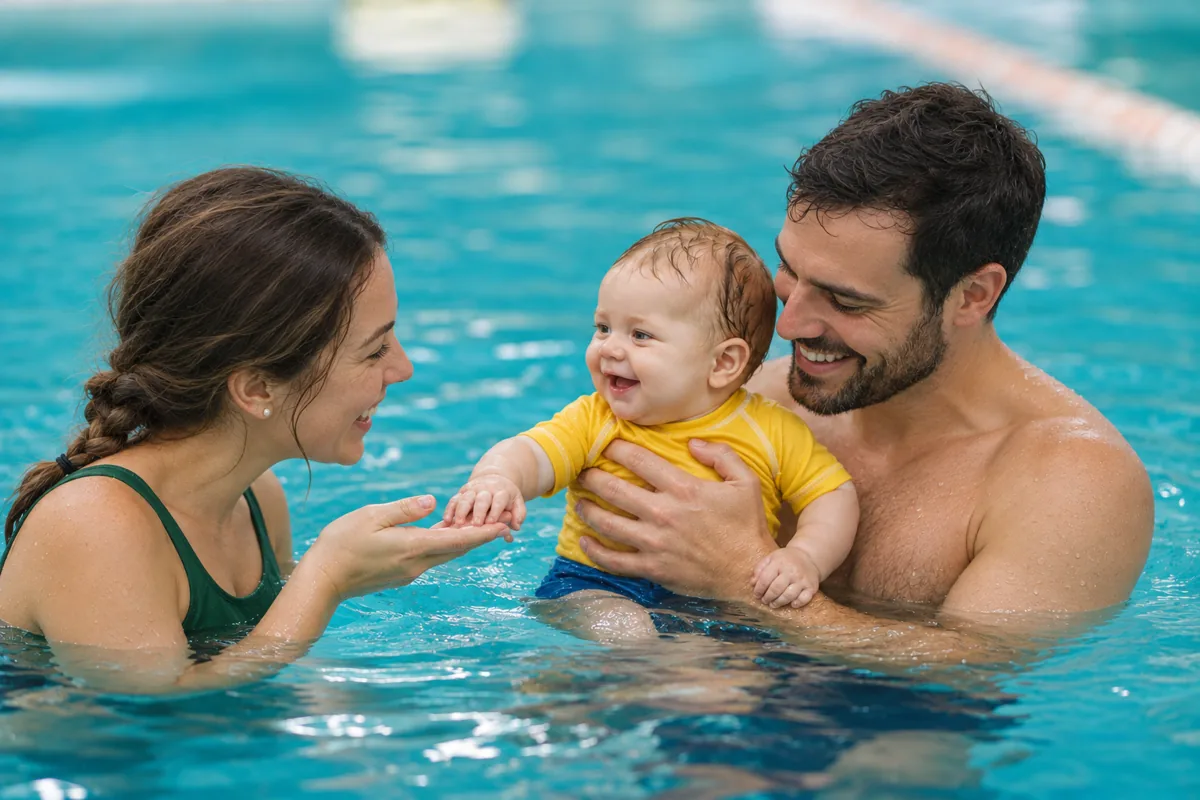
When you visit a swim school, don't just watch the instructor. Watch the babies. Do they seem relaxed? Are they smiling at least some of the time? Are parents in the water with confidence, or do they look confused about what they are supposed to be doing?
Then watch how the instructor handles the one baby who is having a hard day. That single moment will tell you more about the school than any brochure ever could.
Come Meet Our Team at Blue Dolphin Swim School
Blue Dolphin offers several swimming programs in its school pool. Confirm the current instructor’s qualifications and program details, and keep pool familiarity separate from claims of protection in lakes or cold water.
We serve families in Boulder, Louisville, Arvada, Broomfield, Superior, Erie, Thornton, Lafayette, Westminster, and the surrounding communities. If you have been thinking about lessons for your little one, come see us in action.
Learn more about our program on our Baby Love Infant Swim page, or register today to reserve a spot before our next session fills up.
Frequently Asked Questions
What certifications should an infant swim instructor have?
Ask about the actual instructor’s preparation for teaching infants, any current CPR or first-aid credentials, and the school’s supervision and emergency arrangements. Request the relevant details directly rather than inferring a certification from a title or photograph.
Should my child start in a group class or a private lesson?
Blue Dolphin’s Learn to Swim page describes private beginner instruction, while Baby Love offers both parent-child group and private infant options. Discuss your child’s comfort and current skills with the school to choose between the actual available formats; neither format guarantees faster progress.
How can I tell if my baby likes their instructor?
Watch your baby’s face and body during class. Relaxed shoulders, eye contact, smiles, and willingness to try new activities are all good signs. Some tears are normal, especially in the early lessons, but a baby who consistently seems calm and curious around a particular instructor is telling you something important.
Should I switch instructors if my baby cries during every lesson?
Crying can communicate discomfort, fear, tiredness, or other needs. Discuss what you notice with the instructor, ask how activities can be adjusted, and pause when needed. There is no fixed lesson count after which a baby should be expected to feel comfortable.
What is a reasonable class size at each stage?
Class size depends on the specific program. Baby Love Infant Swim I is listed for up to five parent-and-infant pairs, and Learn to Swim is described as one-to-one private lessons. Confirm the class size and support arrangements for the exact next-level class before enrolling.
How long should I stay with the same swim school?
As long as your child is making progress, feels safe, and enjoys going. Consistency matters at this age. Babies build trust with familiar faces and predictable routines, so switching schools too often can slow things down. If you are happy with the instruction, the communication, and your child’s growth, stay put.
Pause & prepare
Take three questions to your next lesson
Think through each question and check it when you have something to discuss. This is a conversation prompt, not a readiness test.
0 of 3 questions considered